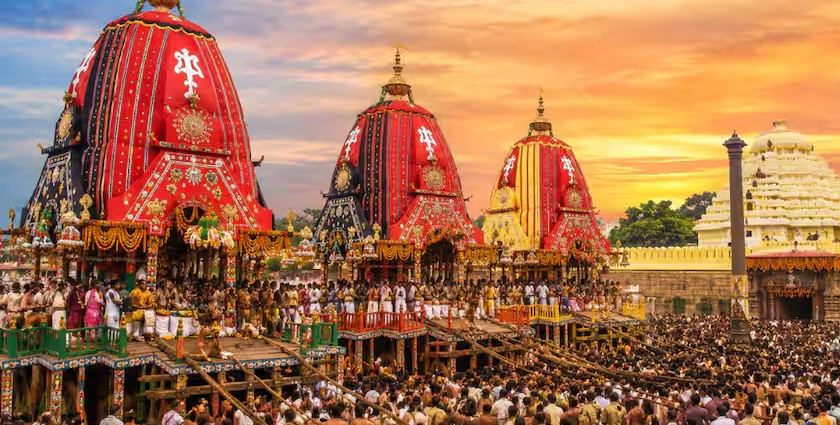
Puri’s Jagannath Rath Yatra is not just a religious festival, but a living symbol of the unwavering love, commitment, and faith between God and his devotees. Every year, on the second day of the bright fortnight of the month of Ashadha, Lord Jagannath, accompanied by his elder brother Balabhadra and sister Subhadra, rides on magnificent chariots to the Gundicha Temple, located approximately 3 kilometers from the Srimandir. The biggest question surrounding this pilgrimage is why the Lord comes here every year and who was Queen Gundicha, known as the Lord’s “aunt”? Let’s explore the mythology and religious significance behind this tradition.
Who Was Queen Gundicha?
According to legend, King Indradyumna of Puri built the magnificent temple of Lord Jagannath. His wife, Queen Gundicha, was a devout and devoted devotee of the Lord. It is said that since they had no children, she loved Lord Jagannath like her own son. Pleased with her devotion, Lord Jagannath promised Queen Gundicha that he would personally visit her home every year. Over time, Queen Gundicha gained the respectable position of Lord Jagannath’s “aunt,” and even today, the Rath Yatra continues that tradition.
Why Is Gundicha Temple So Special?
The Gundicha Temple is not only seen as the resting place of the deity, but also holds immense spiritual significance. According to a popular belief, it was at this very spot that the divine architect Vishwakarma was creating the divine idols of Lord Jagannath, Balabhadra, and Subhadra. According to legend, King Indradyumna opened the doors before the appointed time, leaving the idols unfinished. This is why the idols of Lord Jagannath still appear distinctive and incomplete. This is why the Gundicha Temple holds special honor as the place of the Lord’s manifestation, or Mahavedi.
Why Does Lord Jagannath Stay Here For 9 Days?
During the Rath Yatra, Lord Jagannath, Balabhadra, and Subhadra arrive at the Gundicha Temple and reside there for nine days. During this period, special prayers are offered to them and they are offered the traditional offering of “Poda Pitha,” a traditional prasad from their aunt’s home. This pilgrimage is not merely a religious ritual but a symbol of God fulfilling his promise to his devotees. It conveys the message that God always respects the love and faith of his devotees.
Unique tradition of Hera Panchami:
The most interesting event of the Rath Yatra is considered to be Hera Panchami. While Lord Jagannath resides in the Gundicha Temple, Goddess Lakshmi resides in the Srimandir. On the fifth day, she returns to the Gundicha Temple to call the Lord back. According to folklore, Goddess Lakshmi, angered by the Lord’s delayed return, symbolically damaged a portion of the Lord’s chariot. This tradition is still observed with special religious rituals and remains a center of attraction for devotees.
What Is The Importance Of Bahuda Yatra?
After completing their nine-day stay at the Gundicha Temple, Lord Jagannath, Balabhadra, and Subhadra return to the Srimandir. This return journey is called the Bahuda Yatra or the reverse Rath Yatra. During this time, millions of devotees flock to see the deity. It is believed that attending both the Rath Yatra and Bahuda Yatra bestows special spiritual benefits upon devotees.
Religious Significance Of Aadap Darshan:
During the Rath Yatra, the darshan of the deity at the Gundicha Temple is called Aadap Darshan. Religious belief holds that seeing the deity during this period bestows merit equivalent to performing one hundred Ashwamedha Yagyas. This is why millions of devotees from India and abroad flock to Puri for this occasion.