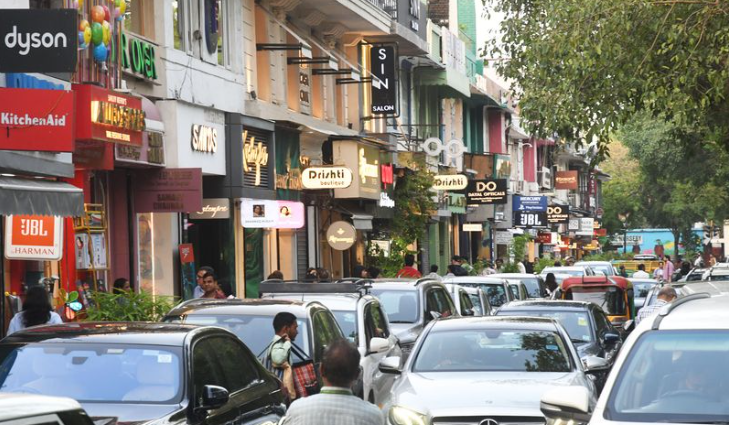
At 75, Khan Market stands as more than just a shopping destination, it is a living archive of Delhi’s social, economic and cultural transformation, having evolved from a modest refugee marketplace in the 1950s into one of the world’s most expensive and vibrant retail hubs.
Established in 1951 by the Rehabilitation Ministry, the market was originally designed to provide livelihood to refugees who had fled the trauma of Partition, particularly from the North West Frontier Province. Built as a U-shaped, double-storey complex with 154 shops and 74 residential flats, it was not conceived as a luxury destination but as a functional, community-driven space.
“Khan Market came into existence around 1950…It was built to rehabilitate people displaced from Pakistan. We were all refugees who came from there,” recalls Sanjiv Mehra, president of the Khan Market Traders’ Association, whose family is among the original settlers.
In its early years, the market reflected the needs of a recovering community. Shops sold essentials, including dairy products, stationery, fabrics and basic provisions. Families often lived above their shops, running small, tightly knit businesses that catered to everyday needs.
“My family ran a departmental store, while others were into dairy, stationery and clothes. That was the core of business here,” Mehra says, describing a time when survival, not branding, defined commerce. But the first shift began gradually with the second generation stepping in. By mid-1970s, particularly during the Emergency, tightening regulations and economic pressures forced many shopkeepers to rethink their businesses.
“We realised the old way of doing business would not sustain. People diversified, some shifted to ready-made garments, others to toys, sports goods and newer retail formats,” Mehra said, adding that he too adapted by moving into the toy business. His shop, ‘Allied Stores’, continues to operate in the market today, selling festive supplies, stationery and toys.
This period marked the beginning of Khan Market’s transformation from a purely utilitarian space into a more adaptive commercial zone. As Delhi expanded and consumer preferences evolved, so did the market.
The third generation accelerated this change, bringing in a more modern outlook. Shops were redesigned, interiors upgraded and a new emphasis on presentation and customer experience began to take shape.
However, the most visible transformation came with the fourth generation in early 2000s — a shift that would redefine Khan Market’s identity.
“That was when the real change happened,” Mehra says, adding “People started renting out spaces, cafés began coming in. Barista was among the first, then Café Coffee Day. That’s when the food culture started taking over.”
With rising footfall and a customer base willing to spend, the market gradually became a magnet for premium brands, boutique stores and upscale eateries.
Legacy eateries like Khan Chacha evolved alongside newer entrants, while international brands tested the waters, though not all could sustain rising rents. Today, Khan Market is synonymous with curated retail and café culture. For a younger generation of visitors, it is less about necessity and more about experience.
“I come here more for the vibe,” says Sara, a Lodhi Colony resident visiting with friends. “It’s a great place for a date and there are so many cafés like Big Chill, Yum Yum Cha, Blue Door Café. Moreover, it’s a very Instagram-friendly place,” Sara adds.
Another visitor, Sargun Bhatiasays. “It’s clean, has international cuisine and high-quality stores. It feels less chaotic than many other markets in Delhi,” she says, adding that despite the high-end positioning, it remains accessible compared to some malls.
What sets the Khan Market apart, however, is not just its present but layered past. Beneath the polished storefronts and bustling cafés lies a history of resilience, of families rebuilding lives, adapting across generations and reshaping a marketplace with each passing decade.
From Rs 50 monthly rents and shops priced at a few thousand rupees to soaring real estate values and global recognition, Khan Market’s journey mirrors Delhi’s own evolution.