Prime Minister Narendra Modi on Saturday flagged concerns over the ongoing West Asia conflict even as he inaugurated the Noida International Airport at Jewar, underlining that global disruptions are already impacting essential supplies and require a united national response.
Linking the inauguration to broader global uncertainties, Modi said the war in West Asia has triggered shortages and price pressures across commodities such as fuel, gas, fertilisers and food. He noted that India’s dependence on crude imports from the region makes the situation particularly sensitive, and asserted that the government is working to shield ordinary families and farmers from the fallout. He urged citizens to respond with calm, patience and collective resolve, calling unity India’s strongest asset in navigating the crisis.
The Prime Minister described the airport launch as a significant step in the “Viksit Bharat” push, marking a new phase in Uttar Pradesh’s infrastructure growth. He said the project reflects both continuity and delivery, recalling that he had laid its foundation stone and was now inaugurating it. He also pointed out the symbolic link between the state and his own political journey.
The international airport is expected to serve a wide belt of western Uttar Pradesh and parts of the National Capital Region, including Agra, Mathura, Aligarh, Meerut and Faridabad.
Modi said the project would open new economic avenues for farmers, small businesses and the youth, while strengthening the region’s integration with global markets. Aircraft operations from the facility, he said, would position the area as a key gateway for trade and mobility.
Without naming any party, Modi took a swipe at previous governments, claiming that earlier political leadership had avoided visiting Noida due to superstition linked to electoral setbacks. He said such fears had held back development, adding that the region is now ready to engage with the world and contribute to India’s growth ambitions.
Highlighting recent infrastructure momentum in western Uttar Pradesh, the Prime Minister cited projects such as the semiconductor facility in Noida, expansion of the Meerut Metro and the rollout of the Delhi-Meerut Namo Bharat corridor. He said these initiatives, along with the airport, are reshaping the region into a major economic hub with improved connectivity.
Modi also drew attention to the area’s emergence as a logistics centre, noting its proximity to dedicated freight corridors linking northern India to ports on both eastern and western coasts. He said this multi-modal network would ensure that agricultural produce and industrial goods from the region can reach global markets faster and more efficiently.
Referring to the airport’s long gestation, he said the project was first approved during the tenure of former Prime Minister Atal Bihari Vajpayee in 2003, but gained momentum only in recent years. He said timely execution has now turned it into an operational asset.
The Prime Minister also highlighted the contribution of farmers, particularly those who parted with land for the project, and linked agricultural output to emerging opportunities in food processing and exports. He noted that ethanol production from sugarcane has helped reduce India’s crude import burden, easing pressure during global supply disruptions.
On aviation, Modi said airports are no longer just infrastructure projects but drivers of economic growth. He noted that India now has more than 160 airports, with Uttar Pradesh accounting for a significant share. He added that government schemes have expanded affordable air travel and are set to further scale up connectivity in smaller towns.
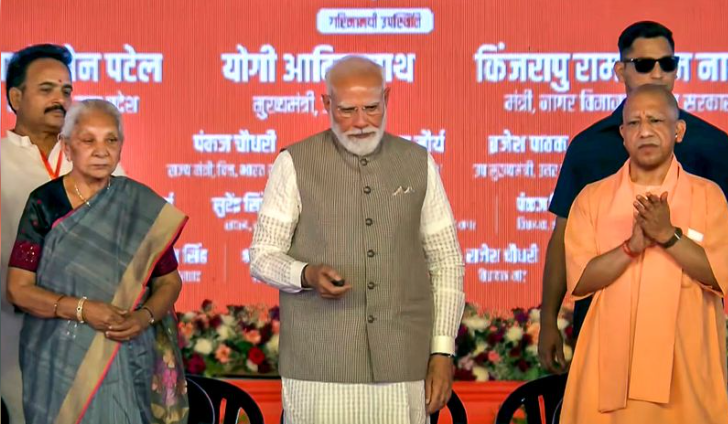
The event was attended by Uttar Pradesh Chief Minister Yogi Adityanath, Governor Anandiben Patel and Union Civil Aviation Minister Ram Mohan Naidu, among others.
Adityanath described the airport as a turning point for the state’s economy, calling it a launchpad for future growth. The Aviation Minister said the project would be developed as an aerotropolis, integrating logistics, cargo and industrial activity, and generating employment in the region.
Built at an estimated cost of about Rs 11,200 crore, the first phase of the airport includes a 4-km runway capable of handling international operations. Authorities expect domestic and cargo flights to begin within weeks, with full-scale international services likely later this year. The new facility, located about 90 km from Delhi’s IGI Airport, is also expected to ease congestion in the National Capital.
Reiterating his message on the global situation, Modi said India’s policy approach would remain centred on national interest, adding that coordinated efforts across political lines would be crucial in dealing with the challenges arising from the West Asia crisis.