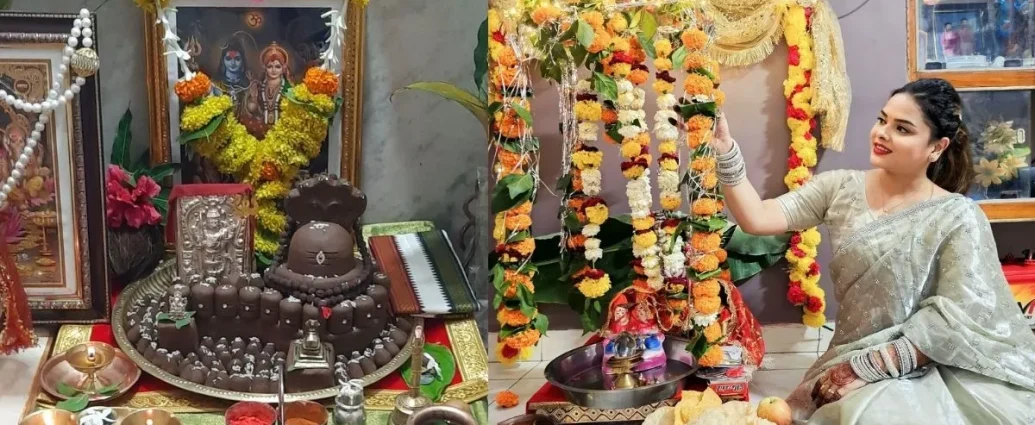
The mention of Hartalika Teej conjures up images of the worship of Lord Shiva and Goddess Parvati, a Nirjala fast, and an all-night puja. However, there’s also a tradition associated with this puja that is said to have a special religious belief. This is the Phulera (flower garland) placed on the puja platform. This pavilion, crafted from flowers, leaves, and various natural plants, is truly beautiful. It’s believed that the Hartalika Teej puja is incomplete without the Phulera. Let’s find out why it is placed, and what connection it has with Shiva and Parvati
Phulera is made from flowers and leaves. It is a natural canopy or pavilion that is placed directly above a Shivalinga made of sand or clay. In Sanatan Dharma , it is considered a symbol of the wedding pavilion of Lord Shiva and Goddess Parvati and their divine protection.
Beliefs related to the five daughters of Mahadev
The garlands of flowers hanging down from the Phulere are considered to represent Lord Shiva’s five daughters: Jaya, Vishhara, Shamilbari, Dev, and Dotali. It is believed that worshipping beneath the Phulere and observing it can resolve marital conflicts. There is also a religious belief that married couples are blessed with children.
Made from special flowers
Instead of using ordinary decorative flowers, Phulera is made using several unique plants found naturally in nature. These include Chilbinia, Navakanchani, Sagaur, Hanuman Sindoori, Dhatura flower, Madar, Binjori, Rang flower, and Mausat flower. It can take approximately 4 to 5 hours to prepare, and its length is said to be approximately 7 feet.
The importance of leaves
Phulere also uses Navabelpatra, Lajjavati (Missing Flower), Sil Bhitai, Shivtai, Himrituli, Charber, Jhanarpatti, Ttilpatti, and seven types of Shami leaves. These natural flowers and leaves are associated with Goddess Parvati’s forest meditation.
Remembering Parvati’s penance
According to mythology, Goddess Parvati performed rigorous penance in the forest to win Lord Shiva as her husband. During this time, she created a Shivalinga from sand and worshipped it with natural flowers and plants. Phulera is considered a symbol of that forest worship and simple spiritual practice.
It is also mentioned in the Puranas
Descriptions of the Hartalika Vrat rituals mention the tradition of decorating the place of worship with natural flowers and leaves. The Bhavishyottar Purana and centuries-old rural traditions also describe the tradition of constructing a pavilion with natural leaves and flowers over a clay idol. This is why the Phulera on Hartalika Teej is considered not just a decoration, but an important part of the worship of Shiva and Parvati and the remembrance of Goddess Parvati’s penance.