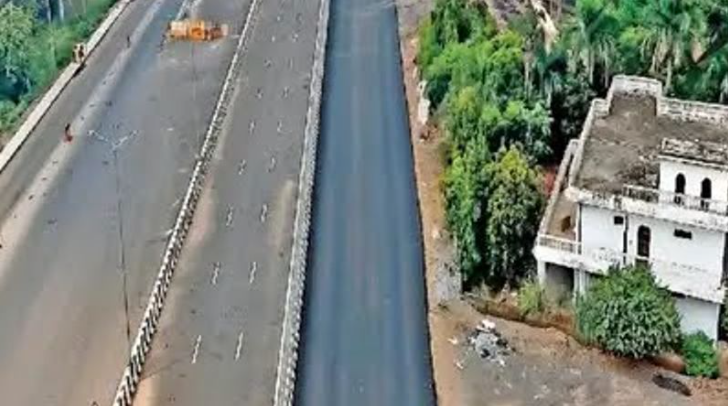
The newly inaugurated Rs 12,000-crore Delhi-Dehradun Expressway, hailed for cutting travel time to just 2.5 hours, has run into a literal roadblock at the Mandola village. A two-storey residential building, boldly named “Swabhiman”, stands squarely in the path of a critical exit ramp, forcing high-speed traffic into a narrow, makeshift bottleneck.
What was intended as a high-tech transit point has instead morphed into a viral sensation. Travellers are frequently seen pulling over to snap photos with the “lone holdout”, which has remarkably topped several local community surveys as the expressway’s number one “selfie point”.
The standoff is the 28-year legacy of a 1998 land acquisition drive by Uttar Pradesh Housing Board. While most local landholders accepted compensation of Rs 1,100 per sq m, Veersen Saroha refused, eventually securing a stay from the Allahabad High Court. Despite the legal freeze, the land was transferred to NHAI in 2020 to facilitate the expressway.
The battle has since escalated to the Supreme Court. The family, now represented by Saroha’s grandson Lakshyaveer and niece Pooja Nehra, challenged the transfer of the “stayed” land. While the apex court recognised the project’s national significance, it redirected the matter to the Lucknow bench of the Allahabad High Court for an expedited final ruling.
The price of progress
“We aren’t anti-development,” the family maintains, “but we cannot be expected to accept 1998 compensation rates in 2026”. They are holding out for current market valuations for their 1,600 sq m plot, arguing that the original offer is now a pittance compared to the land’s current worth.
Safety and logistics in limbo
The physical impact on the 213-km corridor is significant. With the building immovable, NHAI has been forced to bypass the structure with a temporary, narrow service lane. This sudden “squeeze” has become a safety concern for vehicles transitioning toward Delhi or Eastern Peripheral Expressway (EPE), with local observers noting increased congestion and “near-miss” incidents at the site.
As a new judicial bench is constituted to hear the final arguments, “Swabhiman Bhawan” remains a striking symbol of a single family’s resistance, standing tall as the rest of the country speeds past its front door.