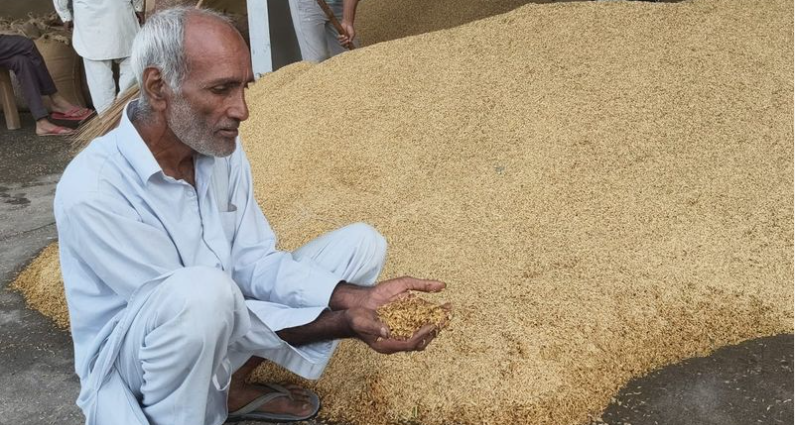
Another spell of heavy rainfall on Thursday morning worsened farmers’ woes across the region, leaving paddy stocks drenched in grain markets and standing crops flattened in several areas. This was the second spell of heavy rain in five days, adding to concerns over crop losses, declining grain quality and delays in procurement.
Farmers, who had been waiting for days for their produce to be procured, said the latest rainfall had further disrupted operations. With paddy lying in the open, fears of deterioration in grain quality have intensified.
They alleged that while auctioned paddy and stocks packed in gunny bags were kept under sheds, their produce remained exposed to rain. They demanded compensation for losses and relaxation in the permissible moisture content for procurement.
Rajnish Chaudhary, chairman of the Haryana Arhtiyas Association, said the rainfall had severely affected paddy quality. Farmers who had earlier harvested 30-32 quintals per acre were now reporting yields of only 25-26 quintals in some cases.
He added that farmers who had already sold their produce at low prices could face further losses, as rice millers might offer lower rates for rain-damaged paddy.
Bagga Singh Sandhu, another arhtiya, called for the deployment of more rice millers to ensure smooth procurement. He said the number of millers operating in Karnal grain markets was considerably lower than during the corresponding period last year.
“Bringing more millers into the process would speed up procurement, lifting, clear space in the mandi and enable farmers to return home sooner,” he said.
Narendra Kumar, another arhtiya, demanded that the permissible moisture limit for procurement be increased from 17 per cent to 20 per cent to provide relief to farmers whose produce had become wet.
Pala Ram, a farmer, said procurement, which had already been progressing slowly, had come to a complete halt following the rainfall. Surinder Kumar, who brought paddy from two acres to the Karnal grain market, said his entire produce had been drenched, adding to labour costs and uncertainty over whether buyers would accept it.
Shiv Kumar, a farmer from Kutail, said small farmers had suffered heavily due to reduced yields, higher charges by combine harvester operators and lower prices in grain markets. He urged the government to assess weather-related losses and provide compensation to affected farmers.
Arhtiyas also flagged a shortage of rice millers, saying it was hampering procurement and lifting operations. Ramesh, another arhtiya, said only four to five millers were operating in the mandi and called for an increase in their numbers to improve competition and support better prices.
Meanwhile, procured paddy packed in gunny bags was also soaked in the grain markets. Farmers alleged that produce already auctioned to procurement agencies or rice millers was kept under sheds, while their own stocks remained exposed to rainfall.
When contacted, an official of the Haryana State Agricultural Marketing Board (HSAMB), Karnal, said sufficient tarpaulins were available in the grain markets and almost all heaps of paddy had been covered during the rainfall.
“No farmer has faced any difficulty,” he said.
Yamunanagar markets face similar woes
Despite being covered with tarpaulins, large quantities of paddy lying in the district’s grain markets got wet following Thursday’s rainfall, raising concerns among farmers and arhtiyas over possible deterioration in grain quality.
The situation has worsened amid slow procurement and lifting, leaving substantial stocks vulnerable to adverse weather conditions.
According to the latest data available with the District Food, Civil Supplies and Consumer Affairs Controller, Yamunanagar, about 31,306 MT of paddy remained unpurchased, while 78,895 MT of the procured crop was awaiting lifting from grain markets.
As many as 1,67,610 MT of paddy had arrived in the district’s grain markets till October 14. Of this, 1,36,304 MT had been procured, but only 78,895 MT had been lifted.
The data showed that 42.12 per cent of the total paddy procured had been lifted so far, highlighting the slow pace of the process. (With inputs from Shiv Sharma)