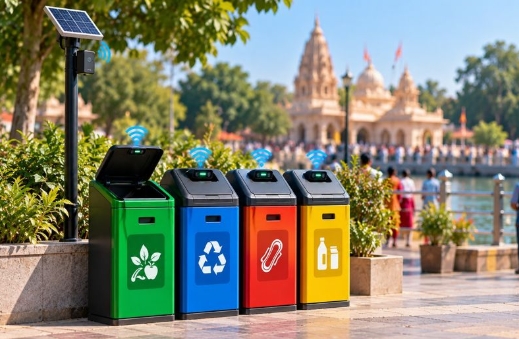
In a technology-driven push for solid waste management at high-footfall tourist and pilgrim destinations, Haryana has devised a strategy that will use Internet of Things (IoT)-enabled bins to collect footfall data, conduct waste audits, and geo-tag littering hotspots.
Pilgrim centres, heritage sites, sacred water bodies, fairs and festivals attract heavy footfall through the year. The waste generated at such places is largely handled through temporary arrangements made for the event. Now, the urban local body concerned will assess each site covering its significance; annual, peak-season and peak-day footfall; and a minimum seven-day waste audit.
The database will be maintained at the urban local body and district levels, consolidated at the directorate, and updated after every assessment.
Compliance with Supreme Court’s directions
A gap analysis will be conducted for sites against the requirements of the Solid Waste Management Rules, 2026, covering sweeping manpower and equipment for twice-daily sweeping, four-stream segregation infrastructure, and waste collection and transportation.
A site-specific solid waste management model will be prepared, providing four-stream segregation and IoT-enabled bins, equipped with sensors that can send real-time data on fill levels and automatically open the lid.
The strategy initially covers Shri Mata Sheetla Devi Mandir in Gurugram, Shri Mansa Devi Mandir in Panchkula and Brahma Sarovar in Thanesar, Kurukshetra.
The Urban Local Bodies Department has prepared the blueprint in compliance with the directions issued by the Supreme Court in Bhopal Municipal Corporation vs Dr Subhash C Pandey and others on May 5. Para 10 of the order directed the Chief Secretaries to identify tourist places and pilgrimage centres to establish a dedicated mechanism to implement the waste management rules.
“The objective is to move waste management at high-footfall destinations from temporary arrangements during fairs and festivals to a site-specific, technology-supported and continuously monitored system,” said Commissioner and Secretary, Urban Local Bodies, Ashok Kumar Meena.
Each site will be divided into the precinct, a buffer of 500 metres covering the approach road, vendor belt, parking and transit route of waste to the processing facility. Four bins will be placed every 50 metres on the route and every 25 metres in the queue corridor. Four stream stations will be set up at fixed points and will have covered storage. There will be no open collection point within the 500-m zone.
There will be dedicated vehicles and litter-picking teams tagged to each site during peak periods. Immersion of floral waste is not allowed. Bhandaras, prasad and flower shops, dharamshalas, hotels and dhabas in the buffer zone will be registered as bulk waste generators with the Central Pollution Control Board.