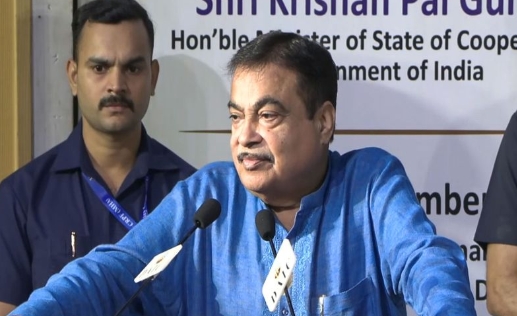
Union Road Transport and Highways Minister Nitin Gadkari again pitched for ethanol and biofuels as a new economic opportunity for the country, calling for agriculture to be diversified beyond food production into energy and fuel.He said farmers could become producers of ethanol, Bio-CNG, aviation fuel, bio-bitumen and other green fuels, helping reduce India’s dependence on imported petroleum while creating new sources of rural income.
“India imports petroleum, diesel and gas worth around Rs 22 lakh crore. A farmer should not be only a food provider. The farmer should also become an energy provider, fuel provider, bitumen provider, hydrogen provider and aviation-fuel provider,” Gadkari said while speaking at an event in Patna.
Gadkari highlighted the expansion of ethanol blending in petrol and stressed that the fuel could help create a new market for agricultural produce while reducing dependence on fossil-fuel imports.
He said flex-fuel vehicles capable of running on high concentrations of ethanol are being developed by major automobile manufacturers, including Toyota, Hyundai, Tata, Mahindra and Mercedes, while two-wheeler manufacturers such as Bajaj, TVS, Hero and Honda have also introduced flex-fuel models. “These vehicles can run on 100% ethanol instead of petrol,” Gadkari said.
Gadkari also said ethanol-based fuel could cost around Rs 70–75 per litre, compared with petrol at around Rs 120 per litre, describing it as an “import substitute, cost-effective, pollution-free and indigenous” fuel. He recalled the government’s decision to promote ethanol production from maize, saying the move initially faced opposition.
According to him, after ethanol production from maize and broken rice expanded, maize prices in Bihar and Uttar Pradesh rose to around Rs 2,628 per quintal, compared with an earlier market price of about RS 1,000 per quintal and an MSP of around Rs 1,800 per quintal. He claimed around Rs 45,000 crore reached farmers in Bihar and Uttar Pradesh as a result.
“Should we import fuel and send that money outside the country, or should we put that money into the pockets of poor farmers in Bihar?” Gadkari asked.
He also highlighted the potential of Napier grass, saying cultivation on around 400 acres could support a project producing about 15 tonnes of fuel or gas. According to Gadkari, such gas could be used to power trucks, buses, cars and two-wheelers, while reducing pollution.
Gadkari said the diversification of agriculture into the energy sector could extend beyond road transport.
He cited the production of bio-aviation fuel from agricultural waste, recalling that he had travelled on a SpiceJet aircraft from Dehradun that was fueled with bio-aviation fuel, with Union Minister Dharmendra Pradhan also present.
“So now the farmer can become an aviation-fuel producer as well,” he said. The minister also highlighted the use of agricultural waste in road construction. He said bio-bitumen produced from rice straw had been used to construct a one-kilometre stretch on the Jabalpur–Nagpur Highway. He further said a research report had found the material to be better than conventional petroleum-based bitumen.
Gadkari said the larger objective was to diversify agriculture towards the energy and power sector, creating additional markets for farmers while reducing India’s dependence on imported fossil fuels.
He urged Bihar to invite automobile manufacturers such as Tata, Mahindra, Toyota, Hyundai and Suzuki and encourage farmers and young people to participate in the emerging ethanol economy.