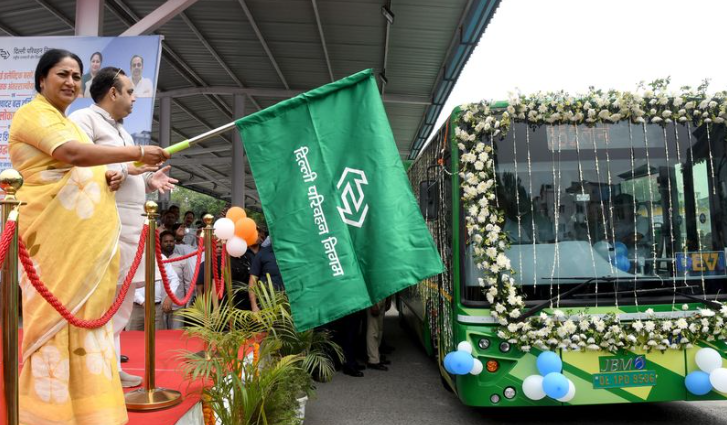
Delhi Chief Minister Rekha Gupta on Friday flagged off 200 electric buses and launched the Delhi-Rohtak interstate e-bus service, along with inaugurating key transport infrastructure projects, marking a major push towards clean and sustainable mobility in the Capital.
The Chief Minister dedicated the Madanpur Khadar bus terminal to the public and inaugurated a newly constructed administrative building at the East Vinod Nagar depot. With the induction of the new buses, Delhi’s total public transport fleet has crossed 6,300, including over 4,500 electric buses, making it the largest such fleet in the country.
Calling it a significant step towards a “clean, green and pollution-free Delhi,” Gupta said the government is rapidly promoting electric mobility. “The objective of every initiative is to provide better connectivity, clean environment and modern transport facilities to citizens,” she said.
Highlighting policy support, the Chief Minister said Rs 4,000 crore had been earmarked over the next four years to accelerate the transition to electric mobility, including incentives for private vehicles and a phased plan to electrify school and commercial vehicles. She also announced plans to set up an EV waste disposal plant in Holambi Kalan to ensure scientific handling of used batteries.
Transport Minister Pankaj Kumar Singh termed the day a “landmark moment” for Delhi’s transport sector. He said the addition of buses, new infrastructure and expansion of interstate services reflect the government’s commitment to building a modern, efficient and commuter-centric system.
The newly launched Delhi-Rohtak e-bus service will operate via ISBT Kashmere Gate, Peeragarhi, Tikri Border, Bahadurgarh and Rohtak, enhancing regional connectivity. Existing interstate electric routes already connect Delhi with cities such as Sonipat, Panipat, Baraut and Dharuhera.
The Madanpur Khadar terminal, located near Kalindi Kunj Metro station, has been equipped with passenger-friendly amenities, including shelters, toilets, ramps for differently-abled and rainwater harvesting systems. Around 22 buses are expected to operate from the terminal across multiple routes.
The East Vinod Nagar depot’s new administrative building includes modern facilities such as biometric systems, staff amenities and safety infrastructure aimed at improving efficiency and working conditions. The facilities at the building are also expected to be differently-abled friendly.
The Delhi Government aims to expand the total bus fleet to nearly 14,000 by 2028-29 as part of its long-term vision for a cleaner and more accessible public transport network.