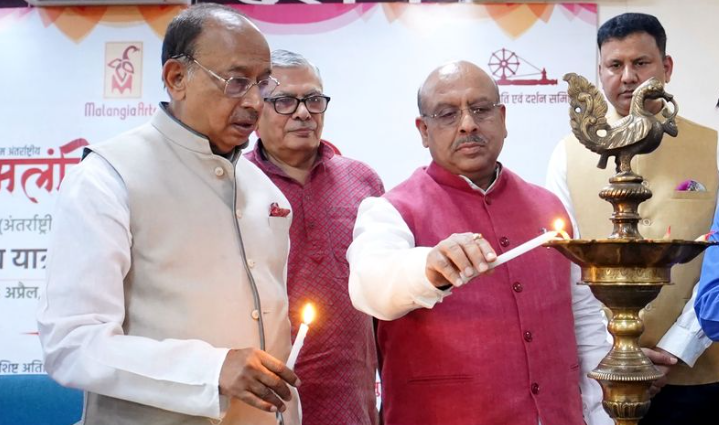
The five-day Malangiya Mahotsav opened at Gandhi Darshan, Rajghat on Friday, with Delhi Assembly Speaker Vijender Gupta inaugurating the festival and hailing it as a vibrant celebration of India’s rich theatrical and literary heritage, while underscoring its role in nurturing regional languages like Maithili.
Attending the inaugural event as the guest of honour, Gupta said the festival, featuring 35 plays written by noted playwright Mahendra Malangiya, reflected a significant expression of Indian culture and artistic continuity. “The participation of over 5,000 writers and theatre practitioners across 22 languages makes this a truly national cultural platform,” he said, adding that the scale of the event merits global recognition, including potential consideration for a Guinness World Record.
The festival, being held from April 24 to 28, has been conceived as a large-scale cultural gathering, bringing together artists, writers and theatre practitioners from across the country. Apart from theatrical performances, the event will host around 30 seminars, conferences, poetry sessions and panel discussions, with participation from over 65 institutions.
Gupta extended his best wishes to the organisers, stating that the festival represented a sustained engagement with India’s diverse linguistic and cultural heritage. He expressed confidence that Malangiya’s body of work would receive wider recognition, adding, “Malangiya’s creations have the potential to find a place in the Guinness Book of World Records.”
The inaugural programme was presided over by Vijay Goel, Vice-Chairman of Gandhi Smriti and Darshan Samiti, who praised Malangiya’s contribution to Indian literature and theatre. He described the playwright as a powerful voice of rural India, whose works captured the nuances of society with sensitivity and depth.
Highlighting Malangiya’s notable works, Goel said his writing reflected the realities of everyday life and resonated with the literary tradition of Munshi Premchand. He noted that the influence of Mahatma Gandhi’s philosophy, particularly his concern for the common man and marginalised communities, was evident in Malangiya’s creations.
Goel emphasised the importance of live theatre in an age dominated by digital content, noting that such festivals helped nurture creativity and values among the youth while offering meaningful cultural engagement