

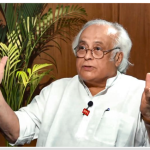
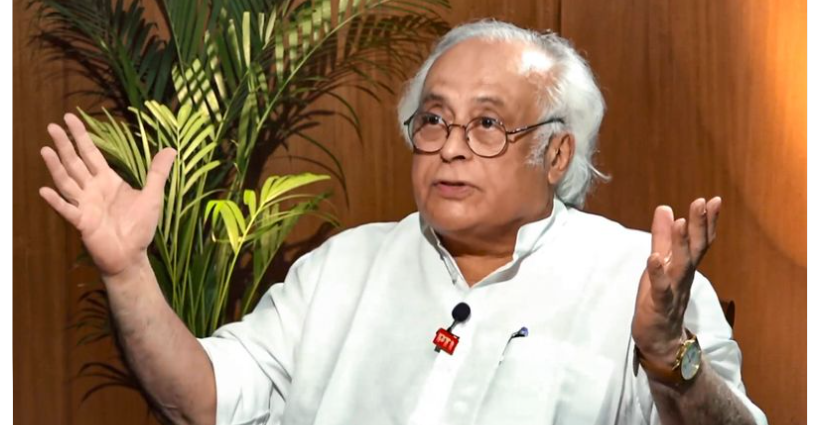
Asserting that Jawaharlal Nehru had a close relationship with the Progressive Writers’ Association, Congress leader Jairam Ramesh on Tuesday dismissed claims that noted lyricist Majrooh Sultanpuri was jailed in 1949 for being critical of India’s first prime minister as a right-wing “propaganda and canard”.
Ramesh said that in 1949, a bunch of communist and progressive writers, including Balraj Sahni, had their passports impounded not by Nehru, but by Morarji Desai, who was the home minister of Bombay then.
“It is the propaganda of the right wing, including Mr (Narendra) Modi, repeatedly saying in Parliament that Majrooh Sultanpuri was put into jail in 1949 for two years in Bombay for calling Mr Nehru a ‘chela’ of Hitler and a ‘Commonwealth ka daas’,” Ramesh said at a talk themed ‘Nehru and the Progressives’ at the Jawahar Bhawan in New Delhi.
“Mr Modi said this on the floor of the House, which others repeated. And of course I challenged them immediately, but as I went back, I’ve been trying to figure out for the last couple of years where this came from. Where did this impression gain ground that Majrooh Sultanpuri was imprisoned by Mr Nehru for two years for having called him a ‘chela’ of Hitler and a ‘Commonwealth ka daas’,” the Congress general secretary said.
“I have now come to the conclusion that the claim was completely bogus, yet it keeps getting repeated. If you go to the internet and search for Majrooh Sultanpuri, you will see ‘Nehru imprisoned him for two years in Bombay between ’49 and ’51’.
“In some internet sources, you would find that he was imprisoned by the governor of Bombay, Morarji Desai. But Morarji Desai was not the governor.
“In some other internet sources, you will find that he was imprisoned by the chief minister of Bombay. But Desai was not the chief minister either. He was the home minister of Bombay… Many such confusions have been created,” Ramesh said.
And the prime minister of India, on the floor of the House, repeats this tale that Mr Nehru was the man who imprisoned Majrooh Sultanpuri, the Congress leader said.
“It’s a complete bunch of lies as it is not borne out by any evidence whatsoever,” Ramesh added.
Ramesh said the relationship between Nehru and the Progressive Writers’ Association was very close and intimate.
Ideologically, the Progressive Writers’ Association was communist, but Nehru was not a communist, he said.
“Nehru was a socialist who was impressed with the Soviet Union; that does not make him a communist. And I think the fundamental difference between the Progressive Writers’ Association and Nehru was that the former did not believe that Nehru was Left enough, that Nehru was not socialist enough, that he compromised with what they called the reactionary forces,” Ramesh said.
Ramesh also recalled how Nehru accepted the presidency of the Sahitya Akademi in 1954 and famously said, “As president of the Sahitya Akademi, I can say with conviction that I would not want the prime minister to interfere in my work.”
Earlier, academic and author Rakshanda Jalil talked at length about the Progressive Writers’ Movement and Nehru at the event.