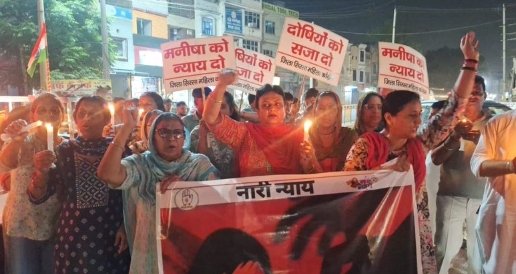
The CBI’s final report in the death of 18-year-old schoolteacher Manisha in Bhiwani district last August has concluded that she died by suicide, but the finding is in sharp contrast to the post-mortem examination conducted at AIIMS, Delhi, which said she had died of injuries caused by a “sharp-edged weapon”.
Manisha’s father, Sanjay Kumar, told ‘The Tribune’ that the family would challenge the CBI’s closure report. The report relies on the findings of two earlier post-mortems — conducted at the Civil Hospital, Bhiwani, and the PGIMS, Rohtak — both of which had concluded that she had died of poisoning.
Advocate Harsh Mohan Singh, former Deputy Legal Adviser of the CBI, has accepted the brief pro bono and will take the proceedings forward on behalf of the family. In another twist, the Super-Speciality Medical Board (SSMB), constituted by the Union Ministry of Health and Family Welfare to examine the conflicting findings of the three post-mortems, also agreed with the conclusions of the Bhiwani and Rohtak hospitals.
‘Papa, I am thankful to you for giving me life as a princess’
Two days after she went missing, Manisha’s body was found on August 13, 2025, at Singhani village in Bhiwani. The body was smudged with straw, grass, weeds and decomposed skin. The facial features and nasal structures were missing and both eye sockets were empty. The neck was dissected. The tongue, pharynx, larynx, thyroid and hyoid were missing.
Manisha was wearing a yellow salwar suit. A white pair of juttis and a blue-and-red chunni were found near the body. A transparent polythene bag containing a handwritten note in black ink in English, a blue purse containing her Aadhaar card and a handwritten suicide note were also recovered.
Her family alleged that she had been raped, her neck had been slashed and her organs had been removed.
A resident of Dhani Laxman village, Manisha had started teaching at Kids Care Play School in Singhani only a month before her death. Vijay Kumar, a driver of the nearby Ideal International School, used to pick her up and drop her off.
On August 11, 2025, Manisha left home for school. At around 1.30 pm, she called Vijay and told him that she had conducted a test and needed to stay back at school to check the answer sheets. At 2.26 pm, she received a call from delivery boy Vikas regarding the delivery of a suit at her house. She called her aunt at 2.29 pm. It was her last call.
CCTV footage from that day showed her going to Devendra Khad Beej Bhandar, where she purchased a one-litre bottle of Shriram Mono pesticide containing monochrotophos at around 2 pm.
Her body was spotted on the morning of August 13, surrounded by seven to eight dogs. Villagers informed the police, and her father, Sanjay Kumar, was called to the spot and identified the body.
Her suicide note read: “…bs mn mer parents ka dream pura krna tha mn bsc NURSINH krki norcet crack krki ek Nursing officer bn ki mer mummy papa ka spna pura krna tha but m aap donua p bhoj nab n skti (I wanted to fulfil the dream of my parents by doing BSc nursing and cracking NORCET. I don’t want to be a burden on both of you)…Papa, I am thankful to you for giving me life as a princess. Koi to please take care of my parents (Someone should take care of my parents).”
Post-mortems at Bhiwani, Rohtak
The first post-mortem, conducted at Civil Hospital, Bhiwani, on August 13, 2025, revealed injuries on both sides of the neck. The mouth, pharynx and oesophagus, along with neck tissues, thyroid, hyoid bone, larynx and trachea, were found missing.
The second post-mortem was conducted at PGIMS, Rohtak, on August 15. It found that the eyelids were missing and the eyeballs were sunken, putrefied and softened. Skin and soft tissues over the mouth were missing at places, with the anterior teeth visible. The heart and lungs had been dissected and the sternum was missing.
The PGIMS post-mortem report further stated: “On exploration of abdominal cavity, lower end of oesophagus, stomach, part of liver, part of small and large intestines, both kidneys, spleen and uterus along with bilateral ovaries are found missing.”
The Regional Forensic Science Laboratory (RFSL), Rohtak, reported that the handwriting on the suicide note was that of Manisha. Her viscera report confirmed the presence of organophosphorus, a common insecticide.
Both hospitals opined that the cause of death was poisoning. PGIMS, Rohtak, further concluded that there were no injuries sustained before death.
AIIMS report
Amid widespread protests and village panchayats and with the family refusing to conduct the cremation, the Haryana Government agreed to its demand for a third post-mortem at AIIMS, Delhi. It was conducted on August 20, 2025.
The AIIMS findings were in complete contrast to those of the state government hospitals. The AIIMS report said the neck was completely dissected, indicating a suspicious and unnatural death. It also said there was no evidence of canine bites on the face or neck.
The AIIMS medical board opined: “The cause of death is massive massacre ante-mortem injury over the neck region caused by a sharp-edged weapon.” It further said the skeletonisation of the face was due to the use of a skin-dissolving fluid that might be corrosive. “There is no sign of any animal bite injury on any part of the body,” the board stated. The AIIMS board also found that Manisha’s viscera showed no evidence of common poisons, including pesticides.
CBI report banks on Super-Speciality Medical Board
With the three post-mortems producing conflicting findings, the CBI requested the Secretary, Ministry of Health and Family Welfare, to constitute a Super-Speciality Medical Board for a comprehensive examination of the case.
A five-doctor SSMB was constituted under Dr Arvind Kumar, Professor, Department of Forensic Medicine, Lady Hardinge Medical College, Delhi. All relevant records were made available to the board. The board rejected the AIIMS findings and concluded that Manisha had died of organophosphorus insecticide poisoning and that the defects on her face and neck were the result of post-mortem predatory and scavenger activity. It also rejected the AIIMS hypothesis that the facial skeletonisation had been caused by a corrosive substance, pointing out that no “corrosive substance on the scalp hair or clothing was detected” in the forensic findings.
The board noted that poisoning had not been detected in the Central Forensic Science Laboratory (CFSL) findings, but said an organophosphorus compound undergoes significant degradation during prolonged storage, particularly when specimens are preserved in non-hermetically sealed containers under ambient conditions.
Based on the SSMB findings, the CBI concluded that there was no foul play and that Manisha had died by suicide. The CBI said she was under severe mental distress over her inability to clear the BSc Nursing entrance examination and her family’s financial condition, which led her to take the extreme step.
She had wanted to marry a school-time friend and had left a separate note for him.