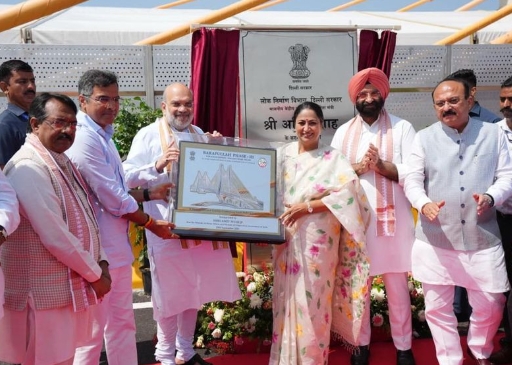
For thousands of commuters travelling from East Delhi and Ghaziabad towards AIIMS and South Delhi, the opening of Barapullah Phase-III on Tuesday is not merely another flyover entering Delhi’s road network. It changes where a substantial chunk of that traffic can travel, taking vehicles away from the congested Sarai Kale Khan stretch of Ring Road and onto a signal-free corridor.
The Rs 1,635-crore project, approved in 2014 and started in 2015, was originally meant to be completed in 2017. Repeated delays pushed the project back by nearly a decade. It was finally inaugurated by Union Home Minister Amit Shah on Tuesday.
The Phase-III stretch links Mayur Vihar Phase-I with Sarai Kale Khan, joining the existing Barapullah network towards AIIMS and South Delhi. The combined corridor is about 9-km long. The flyover reduces travel time between East Delhi and AIIMS to 15 minutes.
This creates a new choice for motorists coming from East Delhi, Ghaziabad and Noida. Instead of entering the heavily used Ring Road section outside Sarai Kale Khan, vehicles travelling towards South Delhi can use the elevated route and continue towards the existing Barapullah corridor.
For commuters heading towards Ashram, a connection near Kalindi Colony also allows traffic to exit before the most congested portion of Ring Road.
PWD officials and transport experts expect a significant redistribution of traffic, although the department has cautioned that the actual reduction in congestion can only be established after traffic patterns settle following the opening.
The bigger civic question is therefore no longer whether Barapullah-III will open, but whether Delhi’s traffic will actually be redistributed rather than merely shifted from one bottleneck to another.
The project itself illustrates the difficulty. Land acquisition, technical, environmental and procedural hurdles delayed construction. A Delhi government social-impact assessment had specifically identified decongestion of the Nizamuddin Bridge, NH-24 bypass, Bhairon Marg and Ashram Chowk as key public benefits.
For commuters, however, the first measure of success will be much simpler: how many minutes are saved and whether the Ring Road queue outside Sarai Kale Khan actually gets shorter. That answer will emerge only after the new traffic pattern has had time to settle.