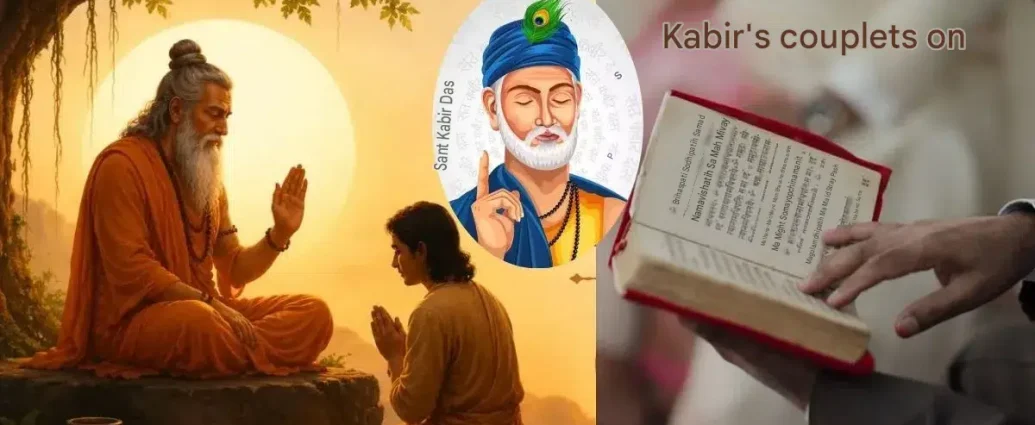
A guru isn’t just a source of bookish knowledge, but also helps students understand the difference between right and wrong and guide them through life. This is why the guru is held in high esteem in Indian tradition . In his couplets, Saint Kabir Das has explained the guru’s glory and the disciple’s dedication in simple yet profound terms. On Teacher’s Day, read these famous couplets by Saint Kabir, which explore the importance of a guru, their teachings, and their guidance.
Glory of the Guru
In Indian culture, the guru is considered the foundation of knowledge and guidance. Saint Kabir Das also emphasized the importance of the guru in his teachings.
Guru is like nectar
This body is a creeper of poison, the Guru is a mine of nectar.
Even if you give your head to get a Guru, consider it cheap.
Meaning: Human life is surrounded by attachment, greed, anger, and other worldly weaknesses. However, the knowledge of a Guru is like nectar, showing us the path to overcome these evils. Therefore, even the greatest sacrifice made to attain true knowledge should be considered less.
refuge in the Guru
Kabira, those men are blind, who call someone else their Guru.
If Hari is angry, there is a place for the Guru, but if the Guru is angry, there is no place for him.
Meaning: In this couplet, Kabir states that it is ignorance to dismiss the importance of a guru by treating them as mere mortals. He describes the guru as a refuge that can guide one through difficult times. According to him, if God becomes angry, the guru provides refuge, but if the guru becomes angry, the person finds no refuge anywhere, meaning that without the guru’s grace, one can never prosper.
There is no limit to the qualities
I could make the entire earth into paper, and all the pens into trees. Even
if I make the seven seas into ink, the Guru’s virtues would still not be written.
Kabir, while describing the vastness of the qualities of the Guru, says that even if the entire earth becomes paper, all the forests become pens and the seven seas become ink, it would still not be possible to fully describe the glory of the Guru in words.
like a master potter
The Guru is the potter and the disciple is the pot, moulding it and removing the flaws.
The inner hand supports it, and the outer hand strikes it.
Meaning: Kabir compares the relationship between a guru and a disciple to that of a potter and a clay pot. Just as a potter shapes the pot, striking it from the outside but also supporting it from within, a guru corrects the disciple’s mistakes. His rebukes and discipline are also driven by the desire to improve the disciple’s future.
There is no knowledge without a Guru.
Without a Guru, knowledge cannot arise, without a Guru, salvation cannot be attained.
Without a Guru, truth cannot be seen, without a Guru, sins cannot be erased.
Meaning: Kabir’s message in this couplet is that without the guidance of a guru, it can be difficult for a person to understand the truth and recognize their shortcomings. A guru’s teachings inspire a person to overcome their flaws and move toward a better life.