








President Droupadi Murmu on Sunday said that Haryana had made significant progress across various dimensions of women’s empowerment and registered an improvement in its sex ratio over the past decade. She also called upon the Central and state governments to make coordinated efforts to achieve parity in the sex ratio.
She appreciated Haryana’s women sportspersons, saying that appropriate encouragement had helped them bring glory to the nation.
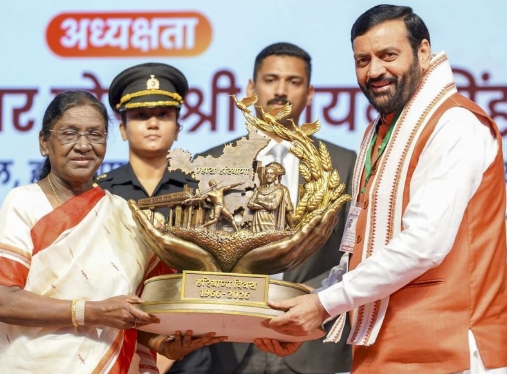
Murmu was in Kurukshetra to attend the Diamond Jubilee celebrations marking 60 years of the state’s formation. On the occasion, she also unveiled the Diamond Jubilee logo.
The President also acknowledged Haryana’s contribution to national security through its armed forces personnel and its role in strengthening the country’s infrastructure.
Addressing the gathering, the President said, “The ‘Beti Bachao, Beti Padhao’ campaign, which was launched from Panipat in January 2015, has proved to be a highly significant initiative towards women’s empowerment. A positive change is taking place in attitudes towards daughters. The sex ratio at birth, which stood at 871 girls per 1,000 boys in 2014, had increased to approximately 915 in November 2025. I hope that coordinated efforts by the state and Central governments will help achieve parity in the sex ratio and further accelerate improvements in women’s health and girls’ education.”
Appreciating the sportspersons, she said, “Haryana’s sportspersons have achieved extraordinary success in India’s sporting history at the Olympics, Paralympics, Asian Games, Commonwealth Games and World Championships.”
Recalling the nation’s freedom struggle, the President said, “During the Quit India Movement, people from Haryana’s rural areas, along with those from its towns and cities, participated enthusiastically. Even young girls came forward fearlessly to take part in these movements. Historical records document the fearless participation of a 12-year-old girl from Rewari in the Civil Disobedience Movement of 1930.
“The girl purchased salt using her entire childhood savings. She had saved two paise every day over several years and devoted the entire amount to the movement. I urge the state government to collect detailed information about this inspiring episode and bring it before society,” she said.
The President said that Haryana had made a remarkable contribution to the development of Indian culture. She added, “Haryana is reaching new milestones in inclusive development. Several deeply rooted social orthodoxies are being dismantled. The processes of holistic development and progressive thinking must advance together in harmony. Coordination with the Central government is giving a new direction to the state’s development.”
On the occasion, Haryana Chief Minister Nayab Singh Saini said that the state’s achievements over six decades had laid a strong foundation for its next goal of becoming India’s first developed state. Haryana would pursue this resolve while playing a leading role in realising Prime Minister Narendra Modi’s vision of Viksit Bharat-2047.
The Chief Minister said that Haryana’s transformation since its formation on November 1, 1966, reflected the determination and enterprise of its people. Once regarded as a backward region, the state had emerged as one of India’s leading and fastest-growing states through the sustained efforts of farmers, workers, industrialists, traders, sportspersons and women.
Haryana Governor Prof. Ashim Kumar Ghosh said that the real strength of Haryana lay in the values rooted in its soil, reflected in the hard work of its farmers, the courage of its soldiers and the discipline of its sportspersons.
Murmu recalls 12-year-old Rewari girl’s courage in freedom struggle
During her visit to Kurukshetra, the President offered prayers at Maa Bhadrakali Shaktipeeth. She also attended the 114th Foundation Day celebrations of Gurukul and the Swami Shraddhanand Martyrdom Centenary Commemoration held at Gurukul Kurukshetra.
During her address, the President recalled how a 12-year-old girl from Rewari had fearlessly participated in the Civil Disobedience Movement of 1930. She urged the state government to collect detailed information about this inspiring episode and bring it before society.