





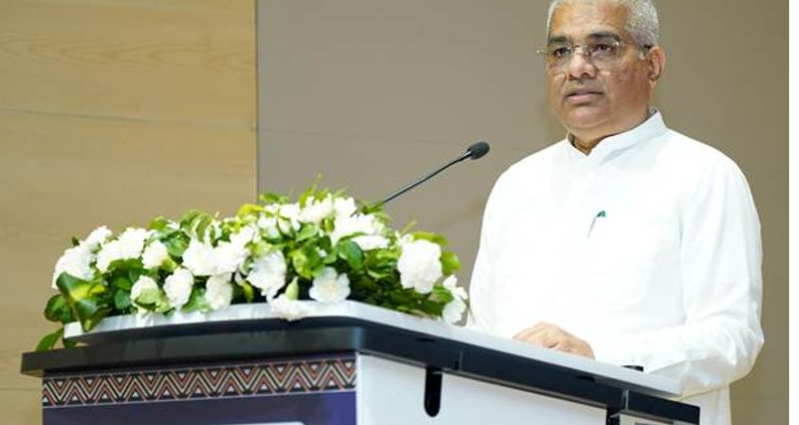
India on Monday urged the international community to shift the global just transition agenda beyond dialogue and exchange of experiences towards practical, country-led implementation, with Union Environment Minister Bhupender Yadav asserting that developing nations must be free to chart their own pathways without facing additional obligations.
Addressing the Fourth Annual High-Level Ministerial Roundtable on Just Transition under the UAE Just Transition Work Programme at the UN climate conference (COP31) in Antalya, Yadav reiterated India’s commitment to an inclusive and equitable transition that leaves no one behind.
He said a just transition should adopt a whole-of-economy and whole-of-society approach, encompassing employment generation, social protection, climate adaptation, poverty eradication, energy access and sustainable development.
Emphasising that there can be no one-size-fits-all model, Yadav said developing countries require adequate financial support, technology transfer and capacity-building to implement their national priorities.
Drawing on India’s experience, he highlighted sub-national heat action and disaster management plans aimed at addressing the vulnerabilities of workers and communities. He also pointed to the country’s rapid renewable energy expansion, which seeks to balance low-carbon growth with affordable energy access.
The minister called for clearly defined and complementary roles for the UAE Just Transition Work Programme and the proposed Just Transition Mechanism. While the Work Programme should remain a platform for dialogue and sharing experiences, the proposed mechanism should focus on providing practical support through technical assistance, capacity-building and international cooperation, he said.
Reaffirming India’s support for operationalising a two-tier, Party-guided Just Transition Mechanism, Yadav said it must respond to the needs of developing countries while respecting national sovereignty and differing national circumstances.
He stressed that the mechanism should build on existing initiatives, avoid duplication and facilitate access to adequate means of implementation. It should neither prescribe uniform sectoral pathways nor create new obligations, but enable countries to pursue transition strategies aligned with their development priorities while safeguarding workers, communities and vulnerable groups.
Describing COP31 as an opportunity to convert discussions into action, Yadav said India was ready to work with all parties towards an inclusive outcome that advances just transition while protecting the developmental interests of developing countries.