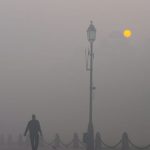









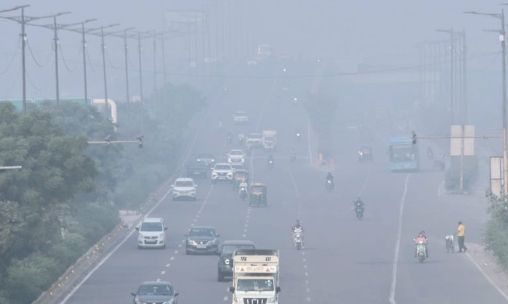
A thick blanket of smog engulfed several parts of the National Capital on Monday morning, a day after Diwali celebrations, with air quality deteriorating to the ‘severe’ category in multiple localities despite restrictions on firecrackers.
Delhi’s average Air Quality Index (AQI) stood at 376, in the ‘very poor’ category, according to the Central Pollution Control Board’s (CPCB) Sameer application. However, several monitoring stations across the city recorded AQI levels above 400, indicating ‘severe’ air quality.
Sonia Vihar recorded the highest AQI at 449, followed by Burari Crossing (445) and Vivek Vihar (441), according to data from a pollution dashboard. Jahangirpuri recorded an AQI of 439, while Delhi University’s North Campus and Rohini registered 437 and 435, respectively.
Other areas reporting ‘severe’ air quality included DTU (431), Bawana (424), Chandni Chowk and Patparganj (418 each), Mundka (413), NIH Narela and Punjabi Bagh (408 each), and the Commonwealth Sports Complex and ITO (404 each).
The deterioration was accompanied by dense smog and reduced visibility in several neighbourhoods, including Inderlok and adjoining residential areas.
The post-Diwali pollution spike has once again raised questions over the enforcement of restrictions on firecrackers. Despite directions issued by the Supreme Court, firecrackers were burst in several parts of the city beyond the permitted hours, including the 10 pm deadline.
Meanwhile, Delhi Minister Kapil Mishra targeted Aam Aadmi Party (AAP) national convenor Arvind Kejriwal, alleging that a campaign was being run from his residence to malign Deepavali under the guise of concerns over pollution.
Official figures also indicated that pollution levels in certain parts of the Capital exceeded the World Health Organisation’s recommended limits by more than 50 times following the continued bursting of firecrackers beyond the Supreme Court’s 10 pm deadline.
The sharp post-festival deterioration has renewed concerns over the effectiveness of pollution-control measures and the monitoring mechanisms in place to track air quality during peak pollution hours.