









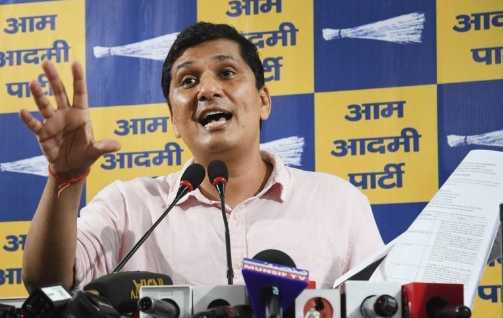
The Aam Aadmi Party (AAP) on Thursday questioned the BJP-led Delhi Government’s claims of having cleaned half of the Yamuna, alleging that videos showing dead fish near the Sonia Vihar stretch of the river had exposed its “fake narrative”.
Party’s Delhi unit president Saurabh Bharadwaj alleged that the fish deaths could have been caused by pollutants in the river and accused the BJP of attempting to mislead people about the condition of the Yamuna.
Reacting to the developments, Bharadwaj said the BJP Government had been projecting the cleaning of the river despite continuing pollution concerns. He also alleged that Water Minister Parvesh Verma was agitated because the Government’s claims had been exposed.
Bharadwaj said the 26-km stretch of the Yamuna from Palla to Wazirabad had always been comparatively clean and had been cleaner during the previous AAP government as well, according to Delhi Pollution Control Committee (DPCC) reports.
He claimed that the Najafgarh drain, which carries around 862 MGD of wastewater, enters the Yamuna near Wazirabad, close to Signature Bridge, and contributes significantly to the river’s pollution downstream.
The AAP leader also alleged that the Haryana Government had been asked by the Centre to release additional fresh water from the Hathnikund barrage around Chhath last year, which diluted the pollutant load in the river. He accused the BJP of using the improved water conditions to project its claims of having cleaned the river.
Referring to last year’s arrangements, Bharadwaj alleged that public money had been wasted on constructing an artificial stretch of the Yamuna using treated water and that Prime Minister Narendra Modi’s proposed visit to take a dip there was subsequently cancelled.
He challenged BJP MP Manoj Tiwari and Water Minister Parvesh Verma to drink water at Kalindi Kunj Ghat.
Meanwhile, the Delhi Jal Board (DJB) said the ammonia concentration in the Yamuna at the Wazirabad pond was approximately 0.5 ppm, which was within the manageable range.
The DJB said the situation was under control and being monitored, with no significant impact on water treatment operations at present. It added that no curtailment in water production was being undertaken and that normal supply operations were continuing without interruption at all water treatment plants dependent on river water as their raw water source.