

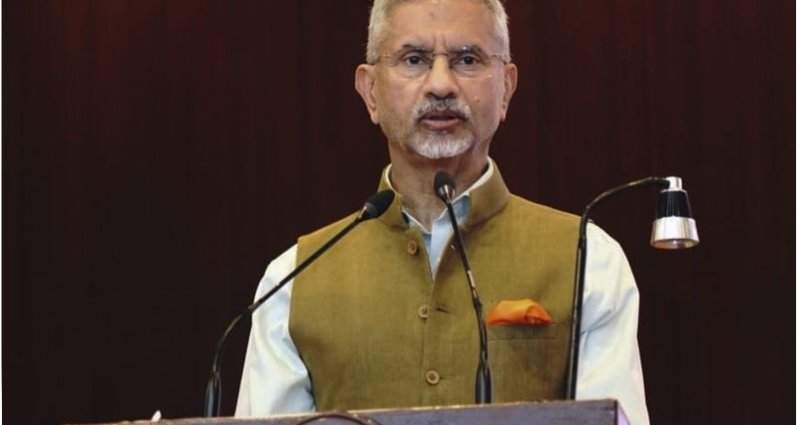
External Affairs Minister S Jaishankar on Saturday said India’s ability to sustain large-scale troop deployment along the China border had improved “in a very marked way” over the past decade, attributing the change to a major push in border infrastructure after years of neglect.
“The border infrastructure was really neglected till about a decade ago,” Jaishankar said at the 24th Hindustan Times Leadership Summit, asserting that the change was evident in the pace of construction of roads, tunnels, bridges and airfields along the frontier.
“If you actually go on the ground and see year by year, how many kilometres of roads, what was the tunnelling, what was the positioning, I think anybody associated with the armed forces dealing with that sector knows the truth,” he said.
Pointing to the growing frequency of infrastructure projects being commissioned along the border, he said the India-China frontier had become “more alive” and required a much greater commitment of troops on a sustained basis.
“The work we had already done allowed that kind of numbers to be deployed out there, and the work we continue to do will maintain those numbers,” he said.
Asked whether India’s ability to maintain and deploy troops along the China border had improved since the 2020 Galwan clash, Jaishankar replied, “Very definitely yes. I would say in a very marked way.”
The minister also linked India’s strategic asymmetry with China to decades of missed opportunities in manufacturing and industrialisation, arguing that the country had lost valuable ground even after the economic reforms of the 1990s.
Recalling that the Indian and Chinese economies were of roughly comparable size around the time of Prime Minister Rajiv Gandhi’s visit to China in 1988, he said Beijing had made a major push towards modernisation and industrialisation in the 1980s, while India had “simply missed the bus”.
He said subsequent governments had failed to sustain the momentum of economic reforms across sectors, with several industrial projects also facing opposition and delays.
“I don’t want you to think of it as a political point,” he said, adding that there had been active opposition to industrialisation in the country about 15-20 years ago, including projects being stalled in the name of environmental concerns.
On India’s response to the economic and technological gap with China, Jaishankar said New Delhi could not compete with Beijing on every front and would have to identify areas where it could make significant advances.
“In asymmetry, you don’t go toe-to-toe on every issue. You pick the issues where you feel you have the ability to make a big jump. And that’s really what we think we’re doing right now,” he said.
He cited the push for domestic manufacturing, semiconductor production, infrastructure development and emerging technologies as important components of India’s effort to build strategic capabilities.
On the emerging global order, Jaishankar described the international situation as one of “very stormy seas”, marked by multiple conflicts, geopolitical competition, economic uncertainty and increasing volatility.
He said the Russia-Ukraine war, the continuing crisis in West Asia and conflicts in Africa had exposed the vulnerabilities of an interconnected world, with disruptions in food and energy supplies affecting economies far beyond the conflict zones.
Predicting continued turbulence until at least the end of the decade, he said the emerging global order would be more multipolar, with greater national assertions, less cohesive alliances and more transactional relationships.
The minister also defended India’s emphasis on self-reliance, manufacturing and domestic capabilities, arguing that an effective foreign policy in the current international environment required stronger economic foundations at home.
“You cannot have an effective foreign policy in this era without much stronger national capacities,” he said.
On the proposed India-US trade deal, Jaishankar said negotiations had reached the “last stretch”, with the bulk of the issues sorted out and both sides working through the remaining differences.
“My understanding… is that we really have the bulk of the issues sorted out. There are last-stretch issues,” he said, adding that India hoped to conclude the agreement soon. He said New Delhi was seeking a mutually beneficial and balanced agreement that would give India a comparative advantage over comparable economies.