





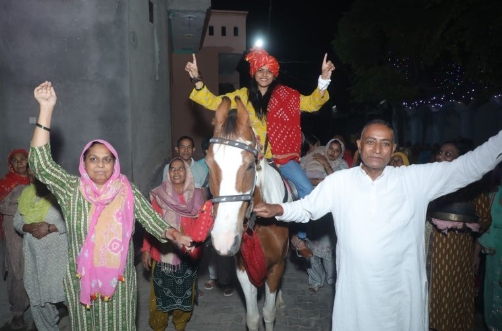
When Swati climbed onto a mare in Chang village to perform the traditional pre-wedding ritual of ‘banwara’, she was doing more than celebrating her upcoming wedding. She was carrying forward a quiet social revolution that began in Bhiwani nearly a decade and a half ago — one that has seen daughters challenge a centuries-old tradition reserved exclusively for grooms.
From Monika to Swati, a growing number of brides in Bhiwani and neighbouring districts have taken to riding mares during their pre-wedding ceremonies, turning a symbol of male privilege into an assertion of gender equality. Accompanied by dancing relatives, villagers, bands and traditional drums, these women have made a powerful statement without uttering a word.
Swati, a resident of Chang village in Bhiwani district, rode a mare during her ‘banwara’ procession on Monday night. She is set to marry Rahul, a resident of Rohtak. Having recently completed her MSc, Swati wanted to be part of a wedding ritual traditionally associated with the groom.
In Haryanvi society, riding a mare during ‘ghurchari’ has traditionally been considered the groom’s exclusive privilege. Swati’s family, however, decided to turn that convention on its head. Her parents, Sher Singh Bibba and Nirmala, said the gesture was intended to convey a simple but powerful message — daughters have an equal right to family celebrations, customs and traditions.
“This is a gesture that highlights that daughters have the same rights as sons. Riding a mare during wedding celebrations should not be considered a privilege reserved for boys,” the couple said.
A retired deputy superintendent in the Haryana PWD Department, Sher Singh said meaningful social change could not be achieved through slogans alone. Families had to translate the ideals of ‘Beti Bachao, Beti Padhao’ into everyday practices.
Sher Singh and Nirmala have three daughters and a son. All three daughters have completed their MSc, while their son Sahil works as an environmental engineer.
Swati’s ride is the latest in a series of similar initiatives that have gradually challenged entrenched gender norms in the region.
The movement traces its roots to Khaparwas village in Bhiwani, where Monika Rani rode a mare during her wedding celebrations in May 2010, becoming one of the first women in the region to challenge the male monopoly over the ritual. Monika Sangwan of Chappar village followed suit the same month. The tradition of breaking traditions gathered momentum over the years. In January 2020, cousins Kanchan and Monika performed ‘ghurchari’ together in Bhiwani. In December that year, sisters Nisha and Neelam of Dhanajogi village rode horses during their wedding celebrations.
In February 2024, Diksha of Thilod village continued the trend by taking out her ‘banwara’ procession on a mare.
The change has not remained confined to Bhiwani. Mamta of Kusser village in Sirsa district rode a mare in March 2016, followed by Kirti in Fatehabad in January 2017 and Neha of Mali Tibba village in Mahendragarh district in April 2026.
What began as individual acts of defiance has gradually become a statement of changing social attitudes. For these brides, riding a mare is not merely about replicating a groom’s ritual; it is about claiming an equal place in traditions that have long celebrated sons differently from daughters. And as Swati joins this growing list, the message from Bhiwani is becoming increasingly difficult to ignore: when it comes to wedding traditions, daughters are no longer willing to remain spectators.